
Sand and media for water filtration
-
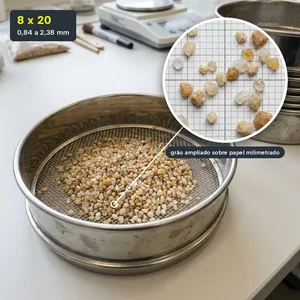 FT-AR-8X20 · Filter sandCoarse filter sand 8 x 20 – 0.84 to 2.38 mmOn request Get a quote
-
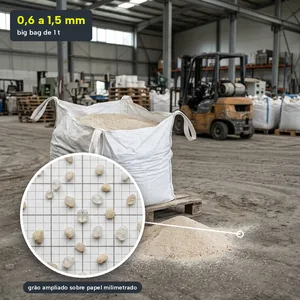 FT-AR-0615 · Filter sandFilter sand 0.60 to 1.50 mm – big bagOn request Get a quote
-
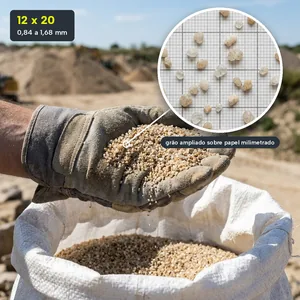 FT-AR-12X20 · Filter sandFilter sand 12 x 20 – 0.84 to 1.68 mmOn request Get a quote
-
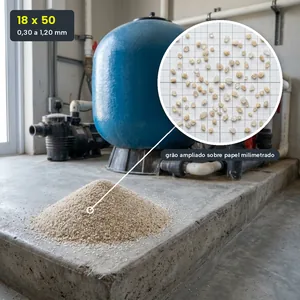 FT-AR-18X50 · Filter sandFilter sand 18 x 50 – 0.30 to 1.20 mmOn request Get a quote
-
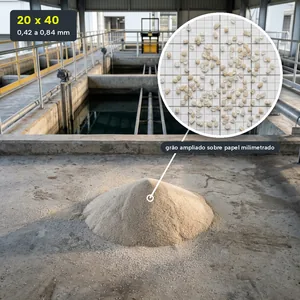 FT-AR-20X40 · Filter sandFilter sand 20 x 40 – 0.42 to 0.84 mmOn request Get a quote
-
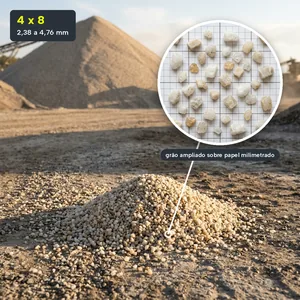 FT-AR-4X8 · Filter sandQuartz filter grit 4 x 8 – 2.38 to 4.76 mmOn request Get a quote
-
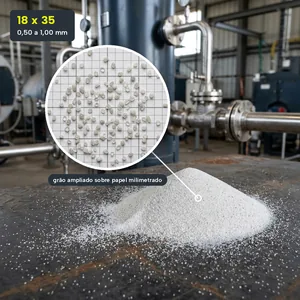 FT-AR-18X35 · Filter sandSilica filter sand 18 x 35 – 0.50 to 1.00 mmOn request Get a quote
No products match these filters. or .
Quartz and silica sand for industrial water filters and water treatment plants, washed, dried and graded by grain size, with a batch report. We supply pulp and paper, chemical, food, utility and building customers in 25 kg bags, big bags or bulk, anywhere in Brazil.
Frequently asked questions
What grain size of sand is used in a water treatment plant filter?
In the rapid gravity filter (the most common type), the filter layer uses 20 x 40 sand (0.42 to 0.84 mm), with an effective size between 0.45 and 0.55 mm and a uniformity coefficient up to 1.6*. The support layers go underneath, from finer to coarser grain. The filter design rules: check the specification before ordering.
What is the difference between quartz sand and silica sand?
Chemically it is the same mineral, silicon dioxide (SiO₂). In the market, "quartz sand" is usually natural pit or river sand with 95 to 99% SiO₂, and "silica sand" the higher-purity grade, white to greyish, free of organic matter and carbonates, used where the water must not pick up colour or hardness.
What are effective size (ES) and uniformity coefficient (UC)?
Effective size is the sieve opening that passes 10% of the sand (D10): it tells how fine the sand filters. Uniformity coefficient is D60 divided by D10: the closer to 1, the more even the grains, the slower the clogging and the better the backwash. Both come from the grain-size test in the batch report.
Which standard should filter sand meet?
In Brazil, ABNT NBR 11799 (filter media: sand, anthracite, expanded clay and gravel), revised in 2024, which covers specification, sampling and tests. Projects with American references call for AWWA B100. We send the batch report with grading, ES, UC and any other tests the project requires.
How often should filter sand be replaced?
There is no fixed interval. Replace or top up the bed when head loss rises too fast after backwash, when sand shows up in the filtered water, when the bed level drops, or when mud balls and channels form. In well-run industrial filters, replacement usually falls between 5 and 10 years*.
How is the sand delivered?
In 25 kg bags (palletised), 1 t big bags or bulk (by m³), depending on volume and site access. Each batch is labelled with its grain size and comes with the report. We deliver anywhere in Brazil; freight and lead time are in the quote.
Can't find the part?
Send us the part number, the machine brand or a photo of the part. We will locate it and quote.