
Needle and holder: what each one does
The needle is the stainless steel tube, with a sharp tip and outlet holes, that goes into the meat and releases the brine (water, salt and curing and flavour ingredients). The holder is the connector that fixes the needle to the injector: the brine enters through it and flows into the needle as it moves down and up through the piece.
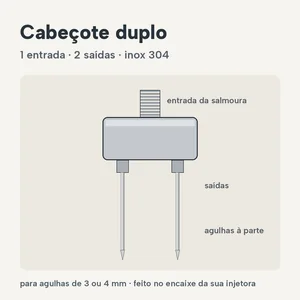
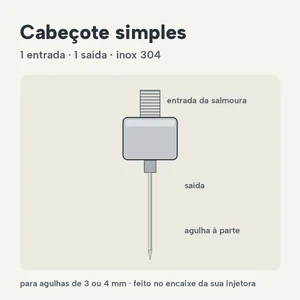
The holder always has one inlet. The single holder has one outlet and takes one needle; the double has two outlets and takes two needles on the same connector.
The result (how much weight the piece gains and whether the colour is even) depends heavily on the condition of the needles: a bent, worn or clogged needle injects less and leaves spots without brine.
Options we make
| Feature | Options | When to use |
|---|---|---|
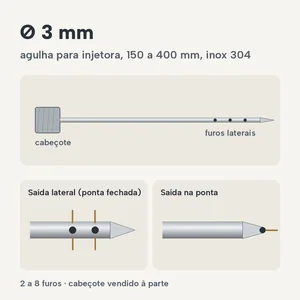
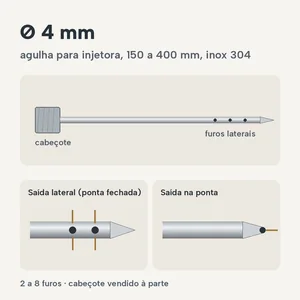
| Needle diameter | 3 mm or 4 mm | 3 mm: smaller pieces, poultry and bacon, fewer marks on the meat. 4 mm: ham, large and bone-in pieces, more viscous brine |
| Needle length | 150 to 400 mm | Depending on the machine's injection height and the thickness of the pieces |
| Outlet holes | 2 to 8 holes | More holes spread the brine better; fewer holes give a stronger jet |
| Hole position | Side or tip | Side: spreads the brine around the needle. Tip: injection deep in the piece, for brine with particles |
| Holder | Single (1 outlet) or double (2 outlets) | Depending on your injector's fitting; both have one inlet |
| Material | 304 stainless steel | Needle and holder |
| Quantity | 20 to 800 needles per injector | Full set or partial replacement |
Side holes or tip outlet
On a side-outlet needle the tip is closed and the holes are in the tube wall, near the tip, on opposite sides. The brine comes out around the needle and spreads better through the fibre; the closed tip also stops pieces of meat from getting in and clogging the needle. It is the most common choice.
On a tip-outlet needle the brine comes out of the end, like a syringe. It suits brine with particles and injection deep into large pieces, but it clogs more easily and marks the piece more.
How many needles to replace
- Small injectors use 20 to 60 needles; industrial ones reach 800.
- A needle that is bent, worn at the tip or has a clogged hole that does not clear on cleaning: replace it right away.
- Many worn needles at once: it pays to replace the full set, so injection is even again across the whole belt.
- A holder leaking at the inlet or with a worn thread: replace it together with the needle.
- Keep replacement stock of about 5 to 10% of the set* so the line does not stop.
Cleaning and care
- Wash needles and holders at the end of each shift with warm water and run clean brine or water through the circuit to remove residue.
- Use the same sanitising programme as the injector; 304 stainless withstands alkaline detergent and chlorinated sanitiser at working concentrations.
- Do not use an ordinary steel brush: it leaves iron particles that rust the stainless steel.
- Store replacement parts dry and protected so the needle tips do not get damaged.