
What filter sand is
It is natural quartz sand, washed, dried and graded on sieves until it falls in a narrow grain-size range. In the filter, water passes through the sand bed and suspended particles are trapped between the grains. When the bed is loaded, backwashing (water in the opposite direction) releases the dirt and returns the filter to service.
What sets filter sand apart from building sand is consistency: hard, clean grains with no clay, organic matter or limestone, almost all of the same size. Irregular grain clogs fast, is lost in backwash and lets turbidity through.
Gradings we supply
The seven ranges below cover the filter layer and the transition and support layers of most filters. The range is given by the control sieves (ASTM/Tyler mesh) and in millimetres. Another range to order: the sand is graded to your filter specification.
| Code | Sieves (mesh) | Range (mm) | Typical effective size* | Main use |
|---|---|---|---|---|
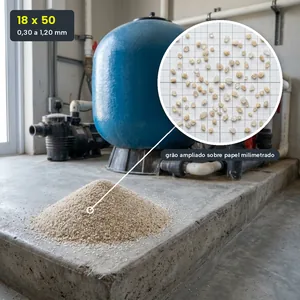
| FT-AR-18X50 | 18 x 50 | 0.30 to 1.20 | 0.35 to 0.45 mm | Swimming pool and effluent filters, pressure filters for low-turbidity water |
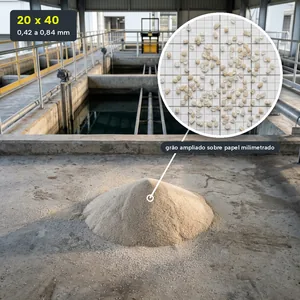
| FT-AR-20X40 | 20 x 40 | 0.42 to 0.84 | 0.45 to 0.55 mm | Filter layer of treatment plant rapid gravity filters and fine layer under anthracite |
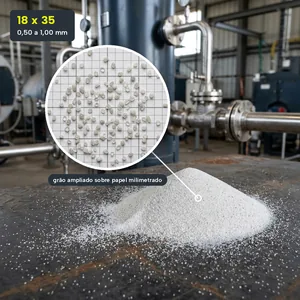
| FT-AR-18X35 | 18 x 35 | 0.50 to 1.00 | 0.55 to 0.65 mm | Industrial pressure filters, boiler and reverse osmosis pretreatment, swimming pools |
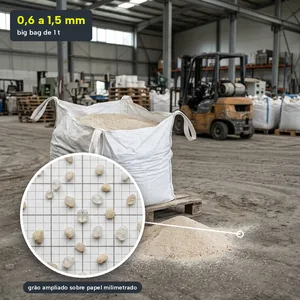
| FT-AR-0615 | — | 0.60 to 1.50 | 0.65 to 0.75 mm | High-flow industrial pressure filters (pulp and paper, chemicals), supplied in big bags |
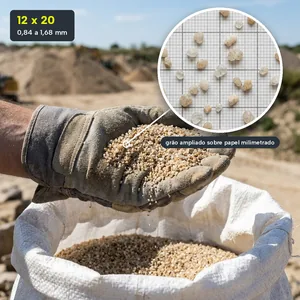
| FT-AR-12X20 | 12 x 20 | 0.84 to 1.68 | 0.90 to 1.00 mm | Upflow filters, raw water, irrigation filters and transition layer |
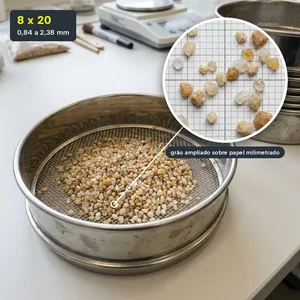
| FT-AR-8X20 | 8 x 20 | 0.84 to 2.38 | 0.95 to 1.10 mm | Coarse layer of upflow filters and transition over the gravel |
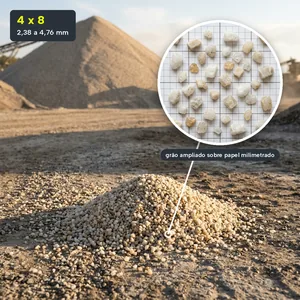
| FT-AR-4X8 | 4 x 8 | 2.38 to 4.76 | not applicable | Top support layer, drains and water well pre-filter |
* Typical reference values. The effective size, uniformity coefficient and grading curve of each batch come in the report.
Origin and processing
The sand comes from quartz deposits in the state of São Paulo, from pits and river beds, with 95 to 99% silicon dioxide (SiO₂). Quartz has a Mohs hardness of 7 and a specific gravity close to 2.65 g/cm³: it does not wear in backwash, does not dissolve in water and does not react with chlorine, coagulant or caustic soda.
After extraction, the material is washed (removing clay and fines), dried, screened and graded to the range ordered. The higher-purity silica sand is free of organic matter and carbonates, so it adds no colour or hardness to the water.
- Quartz sand: 95 to 99% SiO₂, white to yellowish or greyish, sub-rounded grain.
- Silica sand: higher purity, greyish white, no organic matter and no carbonates; suited to process water and reverse osmosis and boiler pretreatment.
- No chemical additives: 100% mineral product.
- Sands from producers with an ISO 9001:2015 certified quality management system.
How to build the filter bed
The bed goes from bottom to top, from coarsest to finest grain. The support layers hold the fine sand and spread the backwash water evenly; the filter layer does the retention. In a dual-media filter, the anthracite (lighter and coarser) sits on top of the sand.
| Position | Material | Grading | Typical depth* |
|---|---|---|---|
| Top | Filter sand | 20 x 40 (0.42 to 0.84 mm) | 60 to 80 cm |
| Transition | Coarse sand | 8 x 20 (0.84 to 2.38 mm) | 7 to 10 cm |
| Support 1 | Coarse sand / grit | 4 x 8 (2.38 to 4.76 mm) | 7 to 10 cm |
| Support 2 to 4 | Gravel | 4.8 to 38 mm, in three or four ranges | 7 to 15 cm each |
| Bottom | False bottom, strainers or nozzles | not applicable | not applicable |
* Reference depths from common designs. The filter specification always rules.
Which sand for each type of filter
- Rapid gravity filter (municipal or industrial plant): 20 x 40 filter layer, effective size 0.45 to 0.55 mm.
- Dual-media filter (sand and anthracite): 20 x 40 sand below; the anthracite comes separately, in the grading of the design.
- Industrial pressure filter (closed vessel): 18 x 35 or 20 x 40 depending on flow and water turbidity; for high-flow filters, 0.6 to 1.5 mm; 4 x 8 support and gravel.
- Swimming pool and effluent filter: 18 x 50 or 18 x 35, depending on the filter manufacturer.
- Upflow filter: 12 x 20 and 8 x 20, with a deeper bed and coarser grain.
- Water well pre-filter and drains: 4 x 8.
- No design at hand: send the flow rate, the filter diameter and height and the type of water. The technical team will recommend the charge.
Specification, tests and report
The reference in Brazil is ABNT NBR 11799 (filter media: sand, anthracite, expanded clay and gravel), revised in 2024, which covers specification, sampling, test methods and application. Projects with American references call for AWWA B100.
- Grading curve (sieving): range, effective size (D10) and uniformity coefficient (D60/D10).
- SiO₂ content and absence of organic matter and carbonates.
- Acid solubility and specific gravity, when the design requires.
- Every batch leaves labelled and with a report. Additional testing by an outside laboratory on request.
Packaging, volume and delivery
- 25 kg bags, palletised.
- 1 t (1,000 kg) big bag, for sites with a forklift or truck crane; loaded without pallets.
- Bulk, sold by m³ (about 1.3 t per m³*), for large volumes.
- To size the charge: bed volume (m³) x 1.5 to 1.6 t/m³* (bulk density of dry, settled sand).
- Collection (FOB) with your own truck: with liner, tarp and ropes (tarping and securing the load are the driver's job) and the driver wearing PPE (long trousers, boots, closed shirt, helmet and mask); loading on working days, by appointment.
- Delivery anywhere in Brazil; freight and lead time are in the quote.
Who we supply
We supply large chemical, pulp and paper and food and beverage companies, as well as petrochemical and mining industries, water and wastewater treatment plants, condominiums, clubs and builders that install or refurbish filters. For a planned bed replacement, the sands for every layer go in a single order; gravel and anthracite on request.
We also supply quartz sand for other industries, on request: foundry moulds, steelmaking inputs and refractories, glass, floors and textures.